MOTORCYCLE SECTION 3: PREPARING TO RIDE
What you do before you begin a ride goes a long way toward riding safely and effectively. Before any ride, a safety-minded rider makes a point to:
- Wear the right gear.
- Become familiar with the motorcycle.
- Check the motorcycle parts and controls.
Wear the Right Gear
When you ride, your gear is “right” if it protects you. In any crash, you have a far better chance of avoiding serious injury if you wear:
- A DOT-compliant helmet.
- Face or eye protection.
- Protective clothing.
HELMET USE
Crashes can occur — particularly among untrained, beginning riders. And one out of every five motorcycle crashes results in head or neck injuries. Head injuries are just as severe as neck injuries — and far more common. Crash analyses show that head and neck injuries account for a majority of serious and fatal injuries to motorcyclists. Research also shows that, with few exceptions, head and neck injuries are reduced when a quality helmet is properly worn.
Some riders choose not to wear a helmet. But, here are some facts to consider:
- A DOT-compliant helmet lets you see as far to the sides as necessary. Studies show that a helmet does not keep a rider from spotting danger minutes after starting out.
- Most riders are riding slower than 30 mph when a crash occurs. At these speeds, helmets can cut both the number and the severity of head and neck injuries by half.
No matter what the speed, helmeted riders are three times more likely to survive head injuries than those not wearing helmets at the time of the crash. The single most important thing you can do to improve your chances if you crash is to wear a securely fastened, quality helmet.
HELMET SELECTION
Recommended are two primary helmet types that provide different levels of coverage: three-quarter and full-face.
Whichever style you choose, you can get the most protection by making sure that the helmet:
- Is designed to meet US Department of Transportation (DOT) and state standards. Helmets with a Snell Memorial Foundation label also provide assurance of quality.
- Fits snugly, all the way around.
- Has no obvious defects such as cracks, loose padding, or frayed straps.
Whatever helmet you choose, keep it securely fastened to your head when you ride. Otherwise, if you are involved in a crash, it might fly off your head before it gets a chance to protect you.
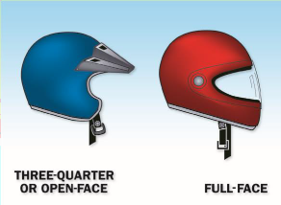
Helmet Selection
EYE AND FACE PROTECTION
A plastic impact-resistant face shield can help protect your whole face in a crash. It also protects you from wind, dust, dirt, rain, insects, and pebbles thrown up from cars ahead. These problems are distracting and can be painful. If you have to deal with them, you can’t devote your full attention to the road.
Goggles protect your eyes, though they won’t protect the rest of your face as a face shield does. A windshield attached to the motorcycle is not a substitute for a face shield or goggles. Most windshields will not protect your eyes from the wind. Neither will eyeglasses nor sunglasses. Glasses won’t keep your eyes from watering, and they might blow off when you turn your head while riding, or in windy conditions.
To be effective, eye or face shield protection must:
- Be free of scratches.
- Be resistant to penetration.
- Give a clear view to either side.
- Fasten securely, so it does not blow off.
- Permit air to pass through, to reduce fogging.
- Permit enough room for eyeglasses or sunglasses, if needed.
CLOTHING
The right clothing protects you. It also provides comfort and protection from heat, cold, debris, and the hot, moving parts of the motorcycle. It can also make you more visible to others.
- Jacket and pants should cover arms and legs completely. They should fit snugly enough to keep from flapping in the wind, yet loosely enough to allow you to move freely. Leather offers the most protection. Sturdy synthetic material provides a lot of protection as well. Wear a jacket even in warm weather to prevent dehydration. Many are designed to protect without overheating you, even on summer days. Some riders choose jackets and pants with “body armor” inserts in critical body areas for additional protection.
- Boots or shoes should be high and sturdy enough to cover your ankles and give them support. Soles should be made of hard, durable, slip-resistant material. Keep heels short so they do not catch on rough surfaces. Tuck in the laces so they won't catch on your motorcycle.
- Gloves allow a better grip and help protect your hands. Your gloves should be made of leather or a similar durable material.
- Hearing protection reduces noise while allowing you to hear important sounds such as car horns or sirens. Long-term exposure to engine and wind noise can cause permanent hearing damage even if you wear a full-face helmet. Whether you choose disposable foam plugs or reusable, custom-molded devices, be sure to adhere to state laws regarding hearing protection.
In cold or wet weather, your clothes should keep you warm and dry while also protecting you from injury. You cannot control a motorcycle well if you are numb. Riding for long periods in cold weather can cause severe chill and fatigue. A winter jacket should resist wind and fit snugly at the neck, wrists, and waist. Good-quality rain suits designed for motorcycle riding resist tearing apart or ballooning up at high speeds.
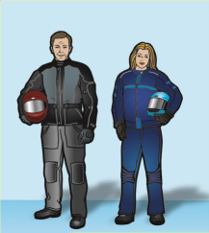
Clothing Options
Know Your Motorcycle
There are plenty of things on the highway that can cause you trouble. Your motorcycle should not be one of them. To make sure that your own motorcycle won't let you down:
- Start with the right motorcycle for you. It should fit you well.
- Read the owner’s manual.
- Be familiar with the controls.
- Check the motorcycle before every ride.
- Keep it in safe riding condition between rides.
- Avoid add-ons and modifications that make it more difficult to handle.
THE RIGHT MOTORCYCLE FOR YOU
First, make sure your motorcycle is right for you. It should “fit” you. Your feet should reach the ground while you are seated on the motorcycle, and the controls should be easy to operate. Smaller motorcycles are usually easier for beginners to operate.
At a minimum, your street-legal motorcycle should have:
- Front and rear brakes
- Turn signals
- Horn
- One left mirror
- Headlight, taillight, and brake light
BORROWING AND LENDING
Borrowers and lenders of motorcycles, beware. Crashes are more likely to occur among beginning riders — especially in the first months of riding. Riding an unfamiliar motorcycle adds risk. If you borrow a motorcycle, get familiar with it away from traffic. And if you lend your motorcycle to friends, make sure they are licensed and know how to ride before allowing them out into traffic.
No matter how experienced you may be, ride extra carefully on any motorcycle that’s new or unfamiliar to you. More than half of all crashes involve riders with less than five months of motorcycle experience.
GET FAMILIAR WITH THE MOTORCYCLE CONTROLS
Make sure you are completely familiar with the motorcycle before you take it out on the street. Be sure to review the owner’s manual. This is particularly important if you are riding a borrowed motorcycle.
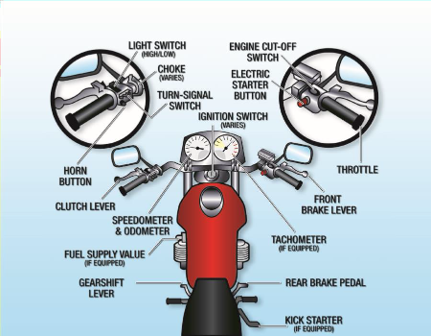
Motorcycle Controls
If you are going to use an unfamiliar motorcycle:
- Check it out thoroughly.
- Find out where everything is, particularly the turn signals, horn, headlight switch, fuel-supply valve, and engine cut-off switch. Find and operate these items without having to look for them.
- Know the controls, work the throttle, clutch lever, brakes, and shifter a few times before you start riding. Be very familiar with the friction zone for manual transmissions.
- Ride very cautiously and be aware of your surroundings. Accelerate gently, take turns more slowly, and leave extra room for stopping.
CHECK YOUR MOTORCYCLE
A motorcycle needs more frequent attention than a car. A minor technical failure on a car is seldom more than an inconvenience for the driver. The same failure on a motorcycle may result in a crash or having to leave your motorcycle parked on the side of the road. If anything’s wrong with your motorcycle, you’ll want to find out about it before you get in traffic.
The primary source of information about how a motorcycle should be manual. Be sure to absorb all of its important information. A motorcycle will continue to ride like new if it is maintained, with routine inspections as part of that maintenance.
A pre-ride inspection only takes a few minutes and should be done before every ride to prevent problems. It’s quick and easy to check the critical components, and it should be as routine and automatic as checking the weather forecast before heading out for the day. A convenient reminder developed by MSF is T-CLOCSSM. There is a T-CLOCS “tear-out” sheet at the back of this manual for you to review. A T-CLOCS inspection should be conducted before every ride, and includes checks of:
T — Tires and Wheels
- Check tire inflation pressure, treadwear, and general condition of sidewalls and tread surface.
- Try the front and rear brake levers one at a time. Make sure each feels firm and holds the motorcycle when fully applied.
C — Controls
- Make sure the clutch and throttle operate smoothly. The throttle should snap back to fully closed when released. The clutch should feel tight and should operate smoothly.
- Try the horn. Make sure it works.
L — Lights and Electrics
- Check both headlight and taillight. Test the switch to make sure both high and low beams work.
- Turn on both right and left-hand turn signals. Make sure all lights are working properly.
- Try both brakes and make sure each one turns on the brake light.
- Clean and adjust mirrors before starting. It’s difficult to ride with one hand while you try to adjust a mirror. Adjust each mirror so you can see the lane behind and the lane next to you. When properly adjusted, a mirror may show the edge of your arm or shoulder – but it’s the road behind you and to the side that are important.
O — Oil and Other Fluids
- Check engine oil and transmission fluid levels.
- Check the brake hydraulic fluid and coolant level, if equipped, weekly.
- Be sure your fuel valve is open, if equipped, before starting out. With the fuel valve closed, your motorcycle may start with only the fuel that is still in the lines, but will stall once the lines are empty.
- Look underneath the motorcycle for signs of an oil or fuel leak.
C — Chassis
- Check the front suspension. Ensure there is no binding. The rear shocks and springs should move smoothly.
- If there is a chain or belt, adjust according to the manufacturer’s specifications, and check the sprockets for wear or damage.
S — Stands
- Ensure the side stand operates smoothly and that the spring holds it tightly in the up position. If equipped, the center stand should also be held firmly against the frame whenever the motorcycle is moving. Additionally, regular maintenance, such as tune-ups and oil changes, is important. Wear and tear are normal with use; routine maintenance will help prevent costly breakdowns. The schedule for regular maintenance of motorcycle parts and controls is in the motorcycle owner's manual.
Know Your Responsibilities
“Accident” implies an unforeseen event that occurs without fault or negligence. In traffic, that is not the case. In fact, most people involved in a crash should probably claim some responsibility for what takes place.
Consider a situation in which someone decides to drive through an intersection while a yellow light is turning red. Your light turns green. You pull into the intersection without checking for possible traffic. That is all it takes for the two of you to crash. It was the driver’s responsibility to stop, and it was your responsibility to look before moving out. Someone else might be the first to start the chain of events leading to a crash, but that doesn't free any of us from our responsibility to reduce risk.
As a rider, you can’t be sure that other operators will see you or yield the right of way. To lessen your chances of a crash occurring:
- Be visible — wear proper clothing, use your headlight, ride in the best lane position to see and be seen.
- Communicate your intentions — use the proper signals, brake light, and lane position.
- Maintain an adequate space cushion when following, being followed, lane sharing, passing, and being passed.
- Search your path of travel 12 seconds ahead.
- Identify and separate hazards.
- Be prepared to act — remain alert and know how to carry out proper crash- avoidance skills, like firm braking or swerving.
Blame doesn’t matter when someone is injured in a crash. The ability to ride aware, make critical decisions, and carry them out separates responsible riders from the rest. Remember, it is up to you to keep from being the cause of, or an unprepared participant in, any crash.
TEST YOUR KNOWLEDGE
- A plastic shatter-resistant face shield.
- Is not necessary if you have a windshield.
- Only protects your eyes.
- Helps protect your whole face.
- Does not protect your face as well as googles.
- More than half of all crashes.
- Occur at speeds greater than 35 MPH.
- Happens at night.
- Are caused by worn tires.
- Involve riders who have less than five months of experience on their motorcycles.
Test answers: (1) 3; (2) 4