Visual Disorders
Category I
VISUAL DISORDERS: Visual acuity and peripheral vision guidelines for safety assessment profiles are as shown. Visual acuity is evaluated for each eye independently, along and both eyes together.
Vision correction may be accomplished with either regular glasses or contact lenses, provided they are used at all times when driving. Safety assessment levels based upon use of visual corrections should be identified by the suffix “C”.
Some of the eye conditions requiring special consideration, but which have no set standards, are listed below. Persons with these conditions may drive if they meet the criteria for acuity and fields.
- COLOR VISION: People who are completely color blind usually suffer from poor visual acuity and possible associated visual field loss. Red-green color discrimination is not important because of traffic light standardization, except in the case of commercial intrastate drivers, who by federal requirement must be able to recognize standard colors or red, green, and amber.
- DARK ADAPTATION: Dark adaptation and glare tolerance are important for safe twilight and night driving, but methods of measurement and standards are not well established. However, individuals with cataracts, retinal abnormalities, chronic pupillary abnormalities, or other known causes of glare intolerance or poor dark adaptations should be carefully evaluated before being recommended for unrestricted licensure. Under certain conditions, a safety assessment level for daytime driving only may be recommended.
- HETERPHORIA: Can occasionally be a cause of driver fatigue. In more severe conditions, it may lead to blurred vision, diplopia, or suppression of vision in one eye. A strabismic person, if diplopia (double vision) is not present, may be regarded as a one-eyed driver. A person with persisting diplopia may be licensed only on the basis of specific medical recommendations.
- STEREOPSIS: Is only important in distances up to 75 feet and therefore relates more to parking, backing, and following closely in city traffic. The best method for testing depth perception on the highway is the driver license examiner's driving skills test.
- MONOCULAR VISION: A person with one eye or correctable vision in one eye to 20/40 may drive non-commercial vehicles. Side mirrors are not required because they are not considered adequate compensatory devices. In certain circumstances, a driver with monocular vision may be approved by the Medical Advisory Board for a commercial intrastate license.
- REFRACTIVE STATES: Myopia (near-sightedness), hyperopia (far-sightedness) and astigmatism (distorted, but constant for all viewing distances) can usually be corrected with glasses or contact lenses, and need not be considered problematic. Likewise, presbyopia (inability to focus clearly on near objects) is natural to aging and is not of licensing concern if compensated.
- TELESCOPIC/BIOPIC LENS: When a person uses a telescopic lens, the visual field is decreased to an extent that the wearer is not qualified to drive. A telescope should not be used when testing the visual acuity for assessing the driver. These types of lenses are not allowed for driving in the state of Utah.
- VISUAL FIELDS: Recent research demonstrates that intact peripheral vision is important for safe driving. An adequate visual field for an unrestricted passenger license is defined as 90 degrees on the horizontal meridian, 45 degrees to both the right and left, and 20 degrees on the vertical meridian both above and below fixation. Individuals diagnosed with glaucoma, retinitis pigmentosa, post panretinal photocoagulation, stroke, brain tumor, or other conditions which restrict peripheral vision, will be required to also submit formal visual field testing using an Esterman field on the Humphrey perimeter, in order to determine the extent of the visual field impairment. A person with a homonymous hemianopsia or a bilateral quadrantanopsia is at increased risk for accidents and is required to be reviewed by the Medical Advisory Board.
- COMMERCIAL INTRASTATE DRIVERS: A driver may qualify for commercial intrastate driving when meeting the requirements of safety assessment levels 2 and 3. Assessment level 3 requires initial MAB approval. If a driver has no previous commercial experience prior to receiving a safety assessment level 3, the driver will be limited to a Class D license with no K restriction allowed.
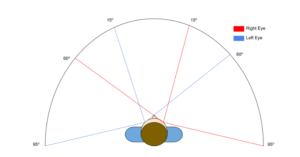
| Level | Central Visual Acuity | Peripheral Visual Fields | Vision Statement Required | Interval for Review | License Class and Restrictions |
|---|---|---|---|---|---|
| 1 | 20/40 or better in each eye AND> | Monocular-120° in each eye; Binocular-70º to the right and to the left in the horizontal meridian | No | N/A | Class D No restrictions |
| 2 | 20/40 or better in better eye or both eyes together AND> | Monocular-120° in each eye; Binocular-60º to the right and to the left in the horizontal meridian | No | N/A | Class D No restrictions |
| 3 | 20/40 or better in better eye or both eyes together AND> | Binocular-120° total, 60º to both the right and left; sighted in only one eye | No | N/A | Class D No restrictions |
| 4 | 20/40 or better in better eye or both eyes together AND> | Binocular VF-at least 90° total with at least 45º to both the right and left | No | N/A | Class D No restrictions |
| 5 | 20/50 to 20/70 in better eye or both eyes together AND> | Binocular VF-at least 90° total with at least 45º to both the right and left | Yes | 2 Years | Class D; speed restriction |
| 6 | 20/80 to 20/100 in better eye or both eyes together AND> | Binocular VF-at least 60° total with at least 30º to the right and left | Yes | 1 Year | Class D; must pass driving skills test; recommended restrictions of speed, area, and daylight only, TBD by examiner |
| 7 | Special circumstances not covered by any of the above with minimum acuity of at least 20/100 AND> | Binocular VF-at least 60° total with at least 30º to the right and left | Yes | As recommended by Medical Advisory Board | As recommended by Medial Advisory Board *(a) |
| 8 | 20/40 or better in better eye or both eyes together AND> | Binocular VF-at least 60º total with at least 30º to the left (includes right homonymous hemianopsia) | Yes | As recommended by Medical Advisory Board | As recommended by Medical Advisory Board *(a) |
| 9 | 20/40 or better in better eye or both eyes together AND> | Binocular VF-at least 60º total with at least 30º to the right (includes left homonymous hemianopsia) | Yes | As recommended by Medical Advisory Board | As recommended by Medical Advisory Board *(a) |
| 10 | Worse than 20/100 in the better eye OR> | Binocular VF-less than 60º | Yes | N/A | No driving |
CLASS A, B, & C VEHICLES
These visual standards only apply when the applicant cannot obtain a federal medical examiner's certificate, "DOT Card".
| Level | Central Visual Acuity | Peripheral Visual Fields | Color Vision | Vision Statement Required | Interval for Review | License Class and Restrictions |
|---|---|---|---|---|---|---|
| 1 | 20/40 or better in each eye AND> | Monocular-120° in each eye; Binocular-70º to the right and to the left in the horizontal meridian | Normal | No | N/A | Class A, B, C No restrictions |
| 2 | 20/40 or better in better eye AND> | Monocular-120° in each eye; Binocular-60º to the right and to the left in the horizontal meridian | Normal | Yes | 2 Years | Class A, B, C No restrictions |
| 3 | 20/40 or better in better eye AND> | Binocular-120° total, 60º to both the right and left; sighted in only one eye | Normal | Yes | 2 Years | Class A, B, C; requires prior commercial vehicle experience documentation and MAB approval |
| 4 | 20/40 or better in better eye AND> | Binocular VF-at least 90° total with at least 45º to both the right and left | N/A | Yes | N/A | No Class A, B, C driving |
| 5 | 20/50 to 20/70 in better eye AND> | Binocular VF-at least 90° total with at least 45º to both the right and left | N/A | Yes | N/A | No Class A, B, C driving |
| 6 | 20/80 to 20/100 in better eye AND> | Binocular VF-at least 60° total with at least 30º to the right and left | N/A | Yes | N/A | No Class A, B, C driving |
| 7 | Special circumstances not covered by any of the above with minimum acuity of at least 20/100 AND> | Binocular VF-at least 60° total with at least 30º to the right and left | N/A | Yes | N/A | No Class A, B, C driving |
| 8 | 20/40 or better in better eye AND> | Binocular VF-at least 60º total with at least 30º to the left (includes right homonymous hemianopsia) | N/A | Yes | N/A | No Class A, B, C driving |
| 9 | 20/40 or better in better eye AND> | Binocular VF-at least 60º total with at least 30º to the right (includes left homonymous hemianopsia) | N/A | Yes | N/A | No Class A, B, C driving |
| 10 | Worse than 20/100 in the better eye OR> | Binocular VF-less than 60º | N/A | Yes | N/A | No driving |