CDL SECTION 3: TRANSPORTING CARGO SAFELY
This section covers:
- Inspecting Cargo
- Cargo Weight and Balance
- Securing Cargo
- Cargo Needing Special Attention
This section explains how to haul cargo safely. You must understand basic cargo safety rules to get a CDL.
If you load cargo incorrectly or fail to secure it, it can pose a danger to others and yourself. Loose cargo that falls off a vehicle can cause traffic problems, and others could be hurt or killed. Loose cargo could hurt or kill you during a quick stop or crash. Your vehicle could be damaged by an overload. Steering can be affected by how a vehicle is loaded, making it more difficult to control.
Whether or not you load and secure the cargo yourself, you are responsible for:
- Inspecting your cargo.
- Recognizing overloads and poorly balanced weight.
- Knowing your cargo is properly secured and does not obscure your view ahead or to the sides.
- Knowing your cargo does not restrict your access to emergency equipment.
If you intend to carry hazardous material that requires placards on your vehicle, you will also need to have a hazardous materials endorsement. Section 9 of this manual has the information you need to pass the hazardous materials test.
3.1 Inspecting Cargo
As part of your vehicle inspection, make sure the truck is not overloaded, and the cargo is balanced and secured properly.
After Starting
Inspect the cargo and its securing devices again within the first 50 miles of the trip. Make any adjustments needed.
Re-Check
Re-check the cargo and securing devices as often as necessary during a trip to keep the load secure. You need to inspect again:
- After you have driven for 3 hours or 150 miles.
- After every break you take during driving.
- Federal, state, and local regulations for commercial vehicle weight, securing cargo, covering loads, and where you can drive large vehicles vary from place to place. Know the rules where you will be driving.
3.2 Weight and Balance
You are responsible for not being overloaded. The following are some definitions of weight you should know.
3.2.1 - DEFINITIONS YOU SHOULD KNOW
Gross Vehicle Weight Rating (GVWR). The manufacturer-specified loaded weight of a single vehicle.
Gross Combination Weight Rating (GCWR). The value specified by the manufacturer of the power unit, if the value is displayed on the Federal Motor Vehicle Safety Standard (FMVSS) certification label; or the sum of the gross vehicle weight ratings (GVWRs) or the gross vehicle weights (GVWs) of the power unit and the towed unit(s), or any combination thereof, that produces the highest value.
(The bold and italicized text above is for use by roadside enforcement only to determine whether the driver/vehicle is subject to CDL regulations. It is not used to determine whether a vehicle is representative for the purposes of skills testing.)
Axle Weight. The weight transmitted to the ground by one axle or one set of axles.
Tire Load. The maximum safe weight a tire can carry at a specified pressure. This rating is stated on the side of each tire.
Suspension Systems. Suspension systems have a manufacturer's weight capacity rating.
Coupling Device Capacity. Coupling devices are rated for the maximum weight they can pull and/or carry.
3.2.2 - LEGAL WEIGHT LIMITS
You must keep weights within legal limits. States have maximums for GVWRs, GCWRs, and axle weights. Often, maximum axle weights are set by a bridge formula. A bridge formula permits less maximum axle weight for axles that are closer together. This is to prevent overloading bridges and roadways.
Overloading can have bad effects on steering, braking, and speed control. Overloaded trucks have to go very slowly on upgrades. Worse, they may gain too much speed on downgrades. Stopping distance increases. Brakes can fail when forced to work too hard.
During bad weather or in the mountains, it may not be safe to operate at legal maximum weights. Take this into account before driving.
3.2.3 - DON'T BE TOP-HEAVY
The height of the vehicle's center of gravity is very important for safe handling. A high center of gravity (cargo piled up high or heavy cargo on top) means you are more likely to tip over. It is most dangerous in curves or if you have to swerve to avoid a hazard. It is very important to distribute the cargo as low as possible. Put the heaviest parts of the cargo under the lightest parts.
3.2.4 - BALANCE THE WEIGHT
Poor weight balance can make vehicle handling unsafe. Too much weight on the steering axle can cause hard steering. It can damage the steering axle and tires. Under-loaded front axles (caused by shifting weight too far to the rear) can make the steering axle weight too light to steer safely. Too little weight on the driving axles can cause poor traction. The drive wheels may spin easily. During bad weather, the truck may not be able to keep going. A weight that is loaded so there is a high center of gravity causes a greater chance of rollover. On flat-bed vehicles, there is also a greater chance that the load will shift to the side or fall off. See Figure 3.1.
3.3 Securing Cargo
3.3.1 - BLOCKING AND BRACING
Blocking is used in the front, back, and/or sides of a piece of cargo to keep it from sliding. Blocking is shaped to fit snugly against cargo. It is secured to the cargo deck to prevent cargo movement. Bracing is also used to prevent cargo movement. Bracing goes from the upper part of the cargo to the floor and/or walls of the cargo compartment.
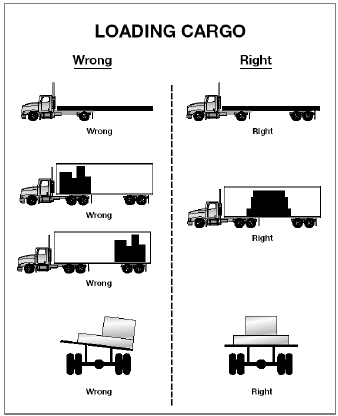
Figure 3.1
3.3.2 - CARGO TIE-DOWN
On flatbed trailers or trailers without sides, cargo must be secured to keep it from shifting or falling off. In closed vans, tie-downs can also be important to prevent cargo shifting, which may affect the vehicle's handling. Tie-downs must be of the proper type and proper strength. Federal regulations require that the aggregate working load limit of any securement system used to secure an article or group of articles against movement must be at least one-half times the weight of the article or group of articles. Proper tie-down equipment must be used, including ropes, straps, chains, and tensioning devices (winches, ratchets, clinching components.) Tie-downs must be attached to the vehicle correctly (hooks, bolts, rails, rings). See figure 3.2.
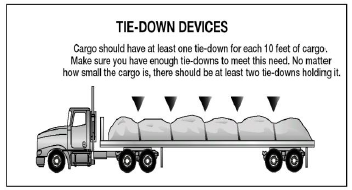
Figure 3.2
Cargo should have at least one tie-down for every ten feet of cargo. Make sure you have enough tiedowns to meet this need. No matter how small the cargo, it should have at least two tie-downs.
There are special requirements for securing various heavy metal pieces. Find out what they are if you are to carry such loads.
3.3.3 - HEADER BOARDS
Front-end header boards ("headache racks") protect your cargo in the event of a crash or emergency stop. Make sure the front-end structure is in good condition. The front-end structure should block the forward movement of any cargo you carry.
3.3.4 - COVERING CARGO
There are two basic reasons for covering cargo:
- To protect people from spilled cargo.
- To protect the cargo from the weather.
Spill protection is a safety requirement in many states. Be familiar with the laws in the states you drive in.
You should look at your cargo covers in the mirrors from time to time while driving. A flapping cover can tear loose, uncovering the cargo, and possibly block your view or someone else's.
3.3.5 - SEALED AND CONTAINERIZED LOADS
Containerized loads are generally used when freight is carried partway by rail or ship. Delivery by truck occurs at the beginning and/or end of the journey. Some containers have their own tiedown devices or locks that attach directly to a special frame. Others have to be loaded onto flatbed trailers. They must be properly secured just like any other cargo.
You cannot inspect sealed loads, but you should ensure you don't exceed the gross weight and axle weight limits.
3.4 Cargo Needing Special Attention
3.4.1 - DRY BULK
Dry bulk tanks require special care because they have a high center of gravity, which can cause the load to shift. Be extremely cautious (slow and careful) when going around curves and making sharp turns.
3.4.2 - HANGING MEAT
Hanging meat (suspended beef, pork, lamb) in a refrigerated truck can be a very unstable load with a high center of gravity. Particular caution is needed on sharp curves such as off-ramps and on-ramps. Go slowly.
3.4.3 - LIVESTOCK
Livestock can move around in a trailer, causing unsafe handling. With less than a full load, use false bulkheads to keep livestock bunched together. Even when bunched, special care is necessary because livestock can lean on curves. This shifts the center of gravity, increasing the likelihood of rollover.
3.4.4 - OVERSIZED LOADS
Over-length, over-width, and/or overweight loads require special transit permits. Driving is usually limited to certain times. Special equipment may be necessary, such as "wide load" signs, flashing lights, flags, etc. Such loads may require a police escort or pilot vehicles bearing warning signs and/or flashing lights. These special loads require special driving care.
SECTION 3 - TEST YOUR KNOWLEDGE
- What four things related to cargo are drivers responsible for?
- How often must you stop while on the road to check your cargo?
- How is Gross Combination Weight Rating different from Gross Combination Weight?
- Name two situations where legal maximum weights may not be safe.
- What can happen if you don't have enough weight on the front axle?
- What is the minimum number of tie-downs for any flatbed load?
- What is the minimum number of tie-downs for a 20-foot load?
- Name the two basic reasons for covering cargo on an open bed.
- What must you check before transporting a sealed load?
These questions may be on your test. If you can't answer them all, re-read Section 3.