MOTORCYCLE SECTION 7: THREE-WHEEL SUPPLEMENT
Know Your Vehicle
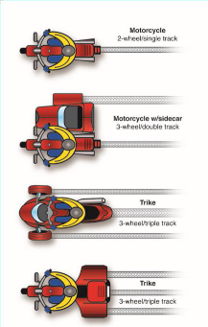
There are many types of three-wheel motorcycles available on the market today. Requirements for licensing three-wheel motorcycles vary by state. In general, three-wheel motorcycles will have the following characteristics:
- Three wheels leave two or three separate tracks during straight-line operation.
- Motorcycle-based conversion or design with:
- Handlebar steering.
- Motorcycle-type controls with the standard layout. Convenience alterations like a single brake pedal or lever control, an automatic clutch, or an automatic transmission.
- Saddle seating:
- Seating in which the rider/ passenger straddles the vehicle.
- If designed for a passenger, the passenger must be seated behind the operator (or in a separate passenger compartment in the case of a motorcycle with a sidecar.)
- Turning diameter of the vehicle at its widest point must be less than 40’.
- The vehicle meets all applicable federal on-road vehicle standards.
The following vehicles are not included in this definition; therefore, testing requirements may not apply. Always refer to your state Department of Motor Vehicles, Department of Licensing, or other appropriate state regulatory agency for exact regulations regarding testing for:
- Automotive hybrids or automotive conversions.
- Vehicles with automotive controls or seating.
- Vehicles with front or rear-mounted engines (engines must be mounted mid-frame below the rider to be considered motorcycle-based.)
- Vehicles with enclosed or semi-enclosed riding compartments.
- Motorcycles or scooters with two close-set wheels in front (contact patches less than 18.1 inches apart) that lean and maneuver like standard, single-track, two-wheel motorcycles.
- Vehicles with any other departure from the above standards.
THREE-WHEEL MOTORCYCLE DESIGNS
Three-wheel motorcycle designs vary among manufacturers. Unlike traditional single-track motorcycles, three-wheel motorcycles can be either dual- or triple-track designs. Dual-track vehicles are motorcycles with sidecars, while triple-track motorcycles can be configured either with dual front wheels or dual rear wheels.
THE RIGHT MOTORCYCLE FOR YOU
Make sure your three-wheel motorcycle or sidecar-equipped motorcycle is right for you. You should be able to comfortably reach and operate all controls and complete full turns using the handlebars.
BORROWING AND LENDING
Borrowers and lenders, beware.
Crashes are fairly common among beginning operators, especially in the first months of riding. Operating an unfamiliar motorcycle adds to the problem. If you borrow a three-wheel motorcycle or a motorcycle with a sidecar, get familiar with it in a controlled area first. If you lend your three-wheel motorcycle or motorcycle with sidecar to friends, make sure they are licensed and know how to ride before you allow them to operate in traffic. Such motorcycles operate very differently from two-wheel motorcycles.
No matter how experienced you may be, be extra careful with any unfamiliar or new vehicle.
GET FAMILIAR WITH MOTORCYCLE CONTROLS
Be sure you are familiar with the controls of a three-wheel motorcycle or a motorcycle with a sidecar before attempting to operate it on any highway, as some controls may differ from those on other motorcycles. This is especially important if you are riding on a borrowed motorcycle. Before beginning the ride:
- Make all the checks you would on your own motorcycle.
- Familiarize yourself with all controls, such as the turn signals, horn, headlight switch, fuel control valve, and cut-off switch. Locate and operate these items without searching for them.
- Operate all the controls before you start riding. Know the gearshift pattern and operate the throttle, clutch, and brakes a few times. Controls react differently on different motorcycles, and the exact locations of controls may vary slightly. Additionally, some motorcycle conversions may be equipped with a single brake pedal or lever control, an automatic clutch, or an automatic transmission.
- As you begin to ride, start out slowly and carefully and be aware of your surroundings. Accelerate gently, take turns slowly, and leave extra room for stopping.
Basic Vehicle Control
STEERING AND TIP
Three-wheel motorcycles handle differently from two-wheel motorcycles. With three wheels on the ground, they are naturally more stable than a two-wheel motorcycle. They also steer differently. Because conventional three-wheel motorcycles cannot lean, they cannot countersteer. Instead, the front wheel is pointed in the direction the rider wants the motorcycle to go.
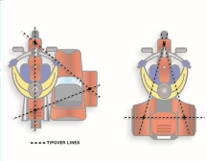
Under certain conditions during operation, a three-wheel motorcycle may have only two wheels in contact with the road surface. This could occur during turning or tight maneuvers when enough weight is transferred beyond the so-called tip-over lines. This tendency requires careful load and passenger positioning inside the tip-over lines to help maintain maximum stability.
BODY POSITION
As with any motor vehicle, the operator's position is important for control and for reducing or preventing fatigue. The operator should be able to reach both handgrips comfortably, since more handlebar movement is necessary than when riding a two-wheel motorcycle. While it is not necessary for the rider of a three-wheel motorcycle to shift weight drastically during operation, shifting weight toward the turn can improve control.
BRAKING
On a motorcycle with a sidecar, during braking in a sharp turn, the sidecar wheel may lift off the ground. Motorcycle and sidecar tires have limited traction or grip on the road surface, and traction is greater when the motorcycle is rolling, not skidding or slipping. During turning, some of the available tire traction is used for cornering, leaving less for stopping. Thus, a skid can occur if you brake too hard.
TURNING
The tendency of the rear inside wheel to lift during turning increases with higher speed and tighter curve radii. During a turn, inertia causes the center of gravity of the motorcycle to shift sideways and outward toward the tip-over line. The reduced weight over the opposite side wheel can cause it to lift slightly.
The weight of a three-track motorcycle is distributed almost equally between the two front or two rear wheels. These motorcycles generally handle the same in left and right-hand turns.
When Turning a Three-Track Motorcycle:
- Approach a turn at speed with your head up, and look through the turn.
- Concentrate on pointing the front wheel/wheels in the direction you want the motorcycle to go.
- Roll off the throttle before entering the turn.
- Apply the brakes enough to slow the motorcycle to a speed at which you can ride safely through the turn, then release the brakes before the turn.
- Slightly lean your upper body in the direction you intend to turn.
- Steer the front wheel/wheels toward the turn.
- Roll on the throttle slightly for stability.
On the other hand, because the center of gravity of a motorcycle with a sidecar is close to the motorcycle itself, the vehicle's behavior when turning right and left is quite different.
During a right turn, a slight sideways movement of the center of gravity creates a greater tendency for the sidecar wheel to lift. The lift will be greater if the sidecar is empty or lightly loaded.
When Turning Right on a Motorcycle with a Sidecar:
- Anticipate the degree of turn required.
- Reduce speed before entering the curve by downshifting or braking.
- Slightly lean your upper body in the direction you intend to turn.
- Maintain speed as you enter the curve.
- Accelerate gradually as you exit the curve.
During a left-hand turn, the sidecar acts as a stabilizer, so the sidecar wheel stays on the ground. However, if the turn is taken too sharply or at too high a speed, the motorcycle's rear suspension may extend, causing the rear wheel to lift off the ground.
When Turning Left on a Motorcycle with a Sidecar:
- Reduce speed prior to entering the turn.
- Apply more pressure on the rear brake than on the front.
HILLS
When riding uphill on a three-wheel motorcycle or a motorcycle with a sidecar, some weight shifts to the rear, making the front of the motorcycle lighter. This weight shift reduces traction on the front tire(s) for steering and tire grip.
When riding downhill, gravity increases the amount of braking force required to slow or stop the motorcycle. It is therefore important to begin slowing earlier for cornering and stopping.
LANE POSITION
The track of the dual wheels of a three-wheel motorcycle or motorcycle with a sidecar is almost the same width as some automobiles. Unlike a motorcycle, you are limited, therefore, in lane positioning. Keep toward the center of the lane to be sure the track of the dual wheels does not cross the painted lines into opposing traffic. Riding too far to the right could cause loss of traction if the tire leaves the pavement.
Lane positioning when riding in groups is also an important consideration. You will not be able to use a staggered formation, such as you would when riding two-wheeled motorcycles. Ride single file and always maintain a safe margin, two seconds minimum, between vehicles.
PARKING AT THE ROADSIDE
Because of the limitations on mobility and motorcycle length, it is not practical to park your motorcycle at a 90° angle with your rear wheel touching the curb, as you would with a two-wheel motorcycle.
Position your motorcycle in a parking space so it is parked parallel to the curb, and set the parking brake. Some three-wheel motorcycles have reverse, so you can more easily maneuver into a parking space designed for an automobile. Parking parallel to the curb will facilitate pulling out and entering the traffic lanes.
ACCELERATION AND DECELERATION
A three-wheel motorcycle with two drive wheels tends to be much more stable during acceleration and braking than a motorcycle with a sidecar. Attaching a sidecar to your motorcycle adds a non-powered, off-center mass of weight. So, during acceleration, the sidecar will feel as though it is lagging behind you, causing the vehicle to feel as though it is being steered to the right.
During deceleration or braking, the momentum of the sidecar continues to carry it forward, giving the feeling that the sidecar is trying to pass you, making the motorcycle feel as though it is being steered left.
- On acceleration, compensate for this tendency by steering slightly in the opposite direction from the sidecar.
- On deceleration, compensate for this tendency by steering slightly in the direction of the sidecar. You can also squeeze the clutch lever when braking.
SWERVING
A quick stop may not always be sufficient to avoid an obstacle in your path, even if you properly apply both brakes. Sometimes the only way to avoid a collision is to swerve. A swerve is any sudden change of direction. It can be two quick turns or a rapid shift to the side when maneuvering the motorcycle. Often, there is not much time to adjust your body position.
A three-wheel motorcycle or motorcycle with a sidecar is not as maneuverable as a two-wheel motorcycle, so plan well ahead to avoid the need for any sudden turns or swerving. If braking is required, brake either before or after the swerve, never while swerving.
CORNERING AND CURVES
The cornering characteristics of a three-wheel motorcycle or motorcycle with a sidecar differ from those of a motorcycle. Even with three wheels on the ground, a sidecar can tip over if it is turned too sharply or if it is going too fast through a corner. Therefore, it is best to always slow down before entering a corner.
The best path to follow in the curve may not be the one that follows the curve of the road. Check opposing traffic carefully, and if safe, enter the curve toward the outside of your lane. This increases your line of sight through the curve and reduces its effective radius. As you turn, move toward the inside of the curve, and as you pass the center, move to the outside to exit, always remembering to stay in your lane.

Carrying Passengers and Cargo
Three-wheel motorcycles are designed to carry passengers and cargo, but do not exceed the tire or motorcycle loading capacity. The extra weight could slightly change the vehicle's handling, so you must consider where the loads are positioned.
Many three-track motorcycles will have built-in storage compartments for cargo, either in front of or behind the rider. On these motorcycles, center the load and keep it low in the storage areas so it is positioned within the tip-over lines and balanced side-to-side. If a passenger is being carried, the passenger will sit directly behind the rider.
On a motorcycle with a sidecar, the best place for a passenger is in the sidecar. Never put a single passenger on the saddle; the added weight on the tipping line will increase the motorcycle's instability. While a second passenger can be carried on the seat behind the rider, the heavier passenger should always be in the sidecar.
When carrying loads in a sidecar, secure them firmly in place, as shifting loads can affect handling. Loads should be distributed toward the rear of the sidecar to reduce tipping of the nose of the sidecar in the event of a sudden left turn.
When loaded, you may find performance is reduced and that stopping distances are longer, so allow some extra distance. Adding a sidecar passenger will greatly improve stability, and right-hand turns can be made at a slightly higher speed. Turning left, however, will require more turning force.